Node.js Releases
Major Node.js versions enter Current release status for six months, which gives library authors time to add support for them. Historically (up to Node.js 26), odd-numbered releases (9, 11, etc.) become unsupported after six months, and even-numbered releases (10, 12, etc.) move to Active LTS status and are ready for general use. Starting with Node.js 27, the release cycle will be annual and every major version will move to LTS status after its six-month Current phase (and six additional months of Alpha phase). LTS release status is "long-term support", which typically guarantees that critical bugs will be fixed for a total of 30 months. Production applications should only use Active LTS or Maintenance LTS releases.
Release Schedule
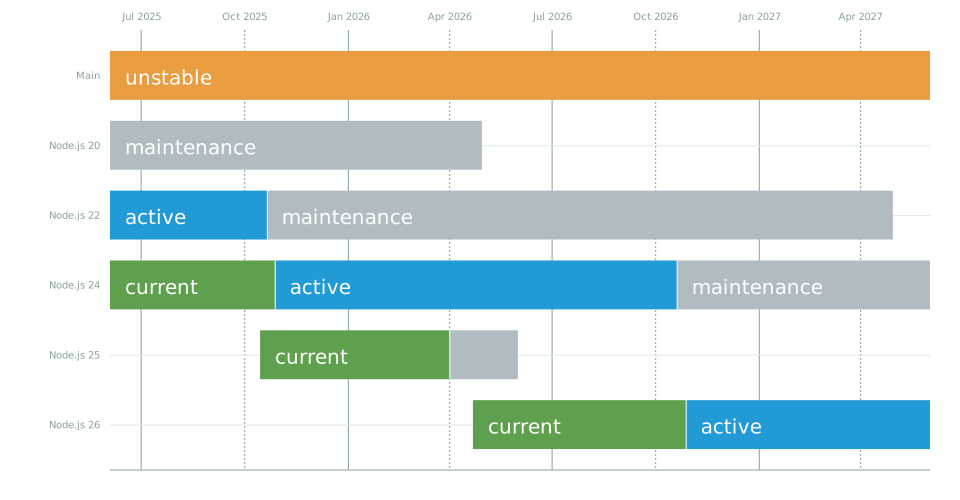
Full details regarding the Node.js release schedule are available on GitHub.
Looking for the latest release of a version branch?
| Node.js | 코드명 | First released | Last updated | Status | |
|---|---|---|---|---|---|
| v26 | - | Current | |||
| v25 | - | EOL | |||
| v24 | Krypton | LTS | |||
| v23 | - | EOL | |||
| v22 | Jod | LTS | |||
| v21 | - | EOL | |||
| v20 | Iron | EOL | |||
| v19 | - | EOL | |||
| v18 | Hydrogen | EOL | |||
| v17 | - | EOL | |||
| v16 | Gallium | EOL | |||
| v15 | - | EOL | |||
| v14 | Fermium | EOL | |||
| v13 | - | EOL | |||
| v12 | Erbium | EOL | |||
| v11 | - | EOL | |||
| v10 | Dubnium | EOL | |||
| v9 | - | EOL | |||
| v8 | Carbon | EOL | |||
| v7 | - | EOL | |||
| v6 | Boron | EOL | |||
| v5 | - | EOL | |||
| v4 | Argon | EOL | |||
| v0 | - | EOL |
Recommended and community installation methods
The Node.js website provides several non-interactive installation methods on the Downloads page, including command-line interfaces (CLIs), operating system (OS) package managers (e.g., brew), and Node.js version managers (e.g., nvm).
To highlight and promote community contributions, the Node.js project introduced a revised Downloads page categorizing installation methods as either “Recommended” or “Community.” This provides users with increased flexibility and choice, while keeping a short, curated list for those who want a straightforward starting point.
Anyone can propose a new installation method for the Downloads page. While the Node.js project makes the final call on what gets listed, proposals are evaluated against the criteria below.
“Recommended” methods are selected for their reliability and close alignment with official releases, and meet the following criteria (in addition to all “Community” criteria):
- “Recommended” methods make new Node.js releases available simultaneously with the official release.
- “Recommended” methods use the official Node.js binaries without alteration, only building from source when pre-built binaries are not available.
- “Recommended” methods have a close relationship with the Node.js project, including direct communication channels.
“Community” methods are additional installation methods also available on the Downloads page, and meet the following criteria:
- “Community” methods must support all currently supported, non-End-of-Life (EOL) Node.js versions.
- “Community” methods must function on at least one officially supported Operating System (OS), and must not be limited to a subset of OS distributions or versions.
- “Community” methods must be free to use and open source, must not be sold as a commercial product, and must not be a paid service.